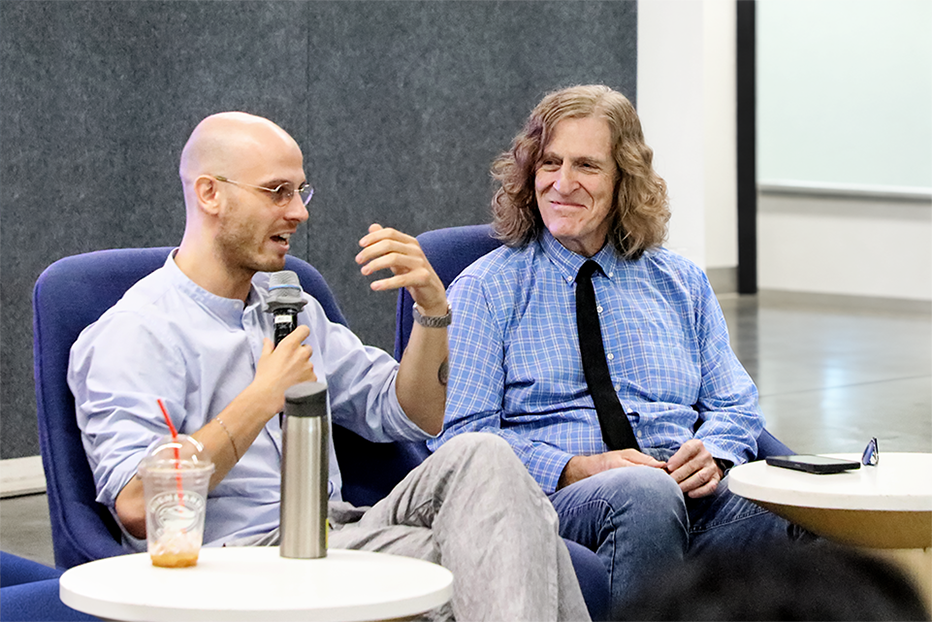
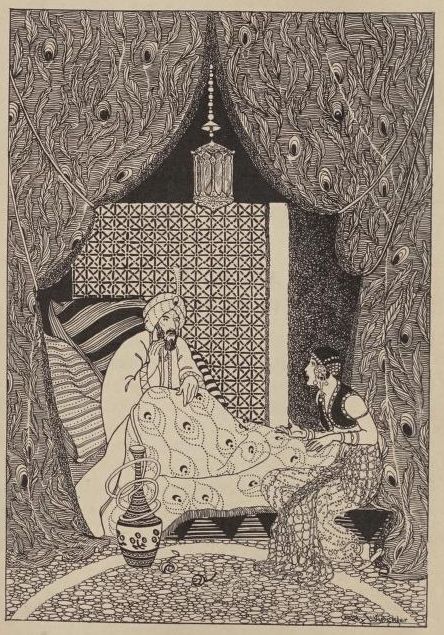
On Monday, October 5, about 175 students and seven faculty members from Fulbright’s core course on “Global Humanities” came together on campus for a conversation on one of world’s most widely recognized works of literature: The One Thousand and One Nights. Apart from being famous, the Nights is also one of the world’s most complicated texts, since its manuscripts evolved over hundreds of years in Syria, Egypt, France, and beyond. The contents of the text have changed over time, but it almost always open with the same premise: a love-scorned king plans to murder all the women of his realm, and one woman, Shahrazad, is determined to stop him by telling stories so compelling that he loses the will to kill her or anyone else.
There are hundreds of stories in the Nights, but there are even more ways to read those stories. During our event, three faculty members—Elizabeth (Liz) Miles, Ian Kalman, and Elsa Costa–gave short talks on how they read The One Thousand and One Nights. Liz and Ian are anthropologists; Elsa is an historian. For this story, their colleague Mark Frank (a fellow historian) brought them together for a follow-up conversation about reading the Nights in the twenty-first century.
Mark Frank: In weeks four and five of Global Humanities, our students read excerpts from The One Thousand and One Nights. Unlike most of the texts we read in that course, I find that many of our students encountered this text in some way during their childhoods, either in the form of an abridged version of the book, or the Disney movie “Aladdin,” or another television or film adaptation. I think the same is true of us, the instructors.
When I read the Nights for the first time as an adult, I was surprised by how intense and mature its themes are. The premise of the entire book is that a king, Shahrayar, intends to marry and then kill all the women of his kingdom one by one because he was cheated on by his wife. Finally, a brave woman named Shahrazad, who is the daughter of the king’s vizier, volunteers to marry the murderous king so that she can save the women of the realm. She comes up with a clever plan: she distracts him night after night by telling lively stories. These stories are full of things he recognizes: betrayal, violence, and power dynamics. Often, these stories have “cliffhanger” endings that require the king to wait another night for the rest of the story, or they lead to other stories: stories within stories. So, one thing that struck me when I revisited the Nights a few years ago is that it is a testament to the power of stories and storytelling.
But that is just scratching the surface. There is so much more to unpack in this text. What can The One Thousand and One Nights teach us about stories and the people who tell them? What did you discover when you revisited the Nights for Global Humanities?
Liz Miles: For me, as for some of my students, the enduring image of The Thousand and One Nights is the “open sesame” scene in the story of “Ali Baba and the Forty Thieves.” Beyond that, I have very little recollection of the story. Like Mark, upon reading the book as an adult, I was struck by the overt sexuality of some of its stories. But, what really stood out to me is not just the sexual themes, but how sexuality is gendered. In class, students and I discussed how to read the story, and one possibility is to read it as a gendered tale. However, it wasn’t until this re-reading that I began to focus not on the women but on the men, particularly the two kings whose “misfortunes” are the catalyst for Shahrazad’s sacrifice.
Mark: Why focus on the men?
Liz: The discussion of women and femininity is well-trod territory when it comes to this work. The richness and multiplicity of the portrayals of women, particularly Marjana in “Ali Baba and the Forty Thieves” and the storyteller Shahrazad, lend themselves to a discussion of gender and agency within a patriarchal system. As a masculinities studies scholar, I chose to focus on the male characters within the frame story, both because this topic is often neglected and because it was a way to bridge the social sciences (my area) and humanities. The “misfortunes” which befall the two kings—Shahryar and Shahzaman—present what masculinities studies scholar and sociologist Raewynn Connell calls a “crisis of the gender order,” and what art historian Kaja Silverman terms “historical trauma.” Though different terms, they both index, in this specific case, how masculine sexual privilege has been upended by women’s adultery with men of lower status. In this interpretation, King Shahryar’s sexual possession and subsequent killing of various women is an attempt to restore the gender order.
However, this then raises the question: does he succeed? In class I introduced the students to the ending of the The One Thousand and One Nights wherein Shahrazad finishes her final story and presents the king with three male children. Shahryar is so overcome by Shahrazad’s gift to him—both the children and his stories—as well as her prostration, that he marries her and the kingdom rejoices. I then asked the students whether this was a return to the original gender order or not. One of the great things about looking at texts in this way is that there is no right answer. The story itself and critical readings of texts ask us to think beyond simple binaries of yes/no, right/wrong, etc.
Ian Kalman: Like Liz, I find the overall arc of the men a bit more interesting from a twenty-first century perspective, not because Shahrazad is boring, but because she’s a bit of a “Mary Sue.” From start to finish, she is a brilliant storyteller and brave savior. Shahryar, on the other hand, starts as a good king, or “a towering knight and a daring champion,” but his character changes. It’s only when he experiences the trauma of his wife cheating on him and then is taken advantage of by an evil woman and her demon that he becomes the depressed king who murders a different woman every night.
Have you ever found yourself at a low point and feeling like things will never get better? That’s Shahryar on his first night with Shahrazad. And over the course of a thousand and one nights, she does something that he would have considered impossible: she heals him with stories (#Icanfixhim).
Mark: How do you heal someone with stories?
Ian: These days we tend to think of “medicine” as something you put in your mouth and swallow to get better. But through my training as an anthropologist, I have learned how for most of human history, medicine was understood not just as chemicals, but as anything that heals. And that’s what Shahrazad’s stories are: a form of medicine. She weaves stories that entertain, but they also rebuild Shahryar’s world from the ground up. In one of those tales, a demon tells a merchant he has no choice but to kill him, but in the end – the demon trades the merchant’s life for three good stories. So too does Shahryar believe that he must kill Shahrazad – and so too does Shahryar trade her life for stories. In another tale, a wealthy man (much like Shahryar) is betrayed by his evil wife but then helped by the daughter of his employee (much like Shahrazad). And so on, for 1001 nights. Every story is a drop of medicine. Through these stories, Shahrazad heals the broken mind of a broken man.
The One Thousand and One Nights remind us that stories not only entertain, but they are medicine. This is something most societies know, but we modern people sometimes forget. Shahrazad is truly a master of her craft in more ways than one.
Mark: I can see that, but it also occurs to me that Shahrazad, the storyteller, is herself a fictional character. So far, we haven’t talked much about the real people who put this text together. We don’t know exactly where all the stories come from, but we do know that some of them were added in the eighteenth century for the first French edition of the book. So, does that edition accurately represent the (mostly) Asian cultures it depicts, or is it an “Orientalist” depiction of Asia? Elsa, I remember that you had some interesting things to say about this.
Elsa Costa: In ‘Global Humanities,’ we place Palestinian American author Edward Said’s Orientalism immediately after the Thousand and One Nights. I have heard students remark on the ‘natural’ connection between the two texts. But is the connection so obvious? Or is the belief that the connection is obvious just more Orientalism? Said has numerous definitions of Orientalism. One of the first ones he offers is the reduction of the Near East to a place of “exotic beings” and “remarkable experiences” on offer to foreign, presumably Western, travelers, who are often portrayed as experts who understand the East better than its own inhabitants. Several of us transition from the Nights to Orientalism by playing the “Arabian Nights” introduction to Disney’s Aladdin, which features a stereotypical Arab merchant referring to his own country as a “faraway place” to an audience of Western youngsters. When folklore travels from one country to another, it may inevitably substitute for genuine knowledge about its place of origin, exoticizing and obscuring it.
Mark: Is there a way to talk about the Nights without continuing those stereotypes about Arab cultures?
Elsa: In my section of the talk, I tried to draw a connection between the Nights and Orientalism which could avoid reproducing the stereotypes Said criticizes. This was the parallel between Hanna Diyab (1677-1765), the author of the “Ali Baba” and “Aladdin” stories in the Nights, and Edward Said (1935-2003). Both men were from an Arab Christian background and had grown up idolizing the West, but were surprised, when they arrived there, to find themselves assaulted with Muslim stereotypes. Diyab was made to wear an Egyptian hat with the dagger and robes of the Muslim Gulf aristocracy before Louis XIV. When Said met his heroes Jean-Paul Sartre and Simone de Beauvoir, they paid him no attention as they reeled off generalizations about a (supposedly homogeneously Muslim) Middle East to the French literati.
Despite these disappointments, Said and Diyab made their mark on literary history. Said succeeded in making the term “Orientalism,” which before his 1978 book meant “Near East studies,” into a dirty word. Diyab may have immortalized his former French employer, the graverobber, archaeologist and alchemist Paul Lucas, the man who concocted Diyab’s ‘Islamic’ court dress, as the wily foreign magician known as Jafar in the Disney adaptation, who sends Aladdin into a cave in pursuit of a lamp and a ring, as Lucas had sent Diyab and other strays recruited for the purpose twice on the road from Syria to Tripoli.
Diyab’s sojourn in the West was not all disappointing. Some believe that he modeled the character of Marjana in “Ali Baba,” and by extension his version of Shahrazad, on Madame de Maintenon, the commoner who won Louis XIV’s heart and hand in marriage with her talents as a writer. Diyab and Maintenon developed a friendship of sorts, and it is possible that he saw himself in her too: as Ian and Liz (more equivocally) gestured at, Shahrazad is the subaltern who speaks, reorienting the center of mass from which narration occurs and is perceived, bringing not canned ‘magic from the East’ but genuine justice and healing.
Editor’s Note: Global Humanities is offered every year to all freshman students at Fulbright. It covers a wide range of texts, from the ancient world to the twenty-first century.
Image: https://egyptianstreets.com/
Mark Frank, Elizabeth Miles, Ian Kalman, and Elsa Costa